
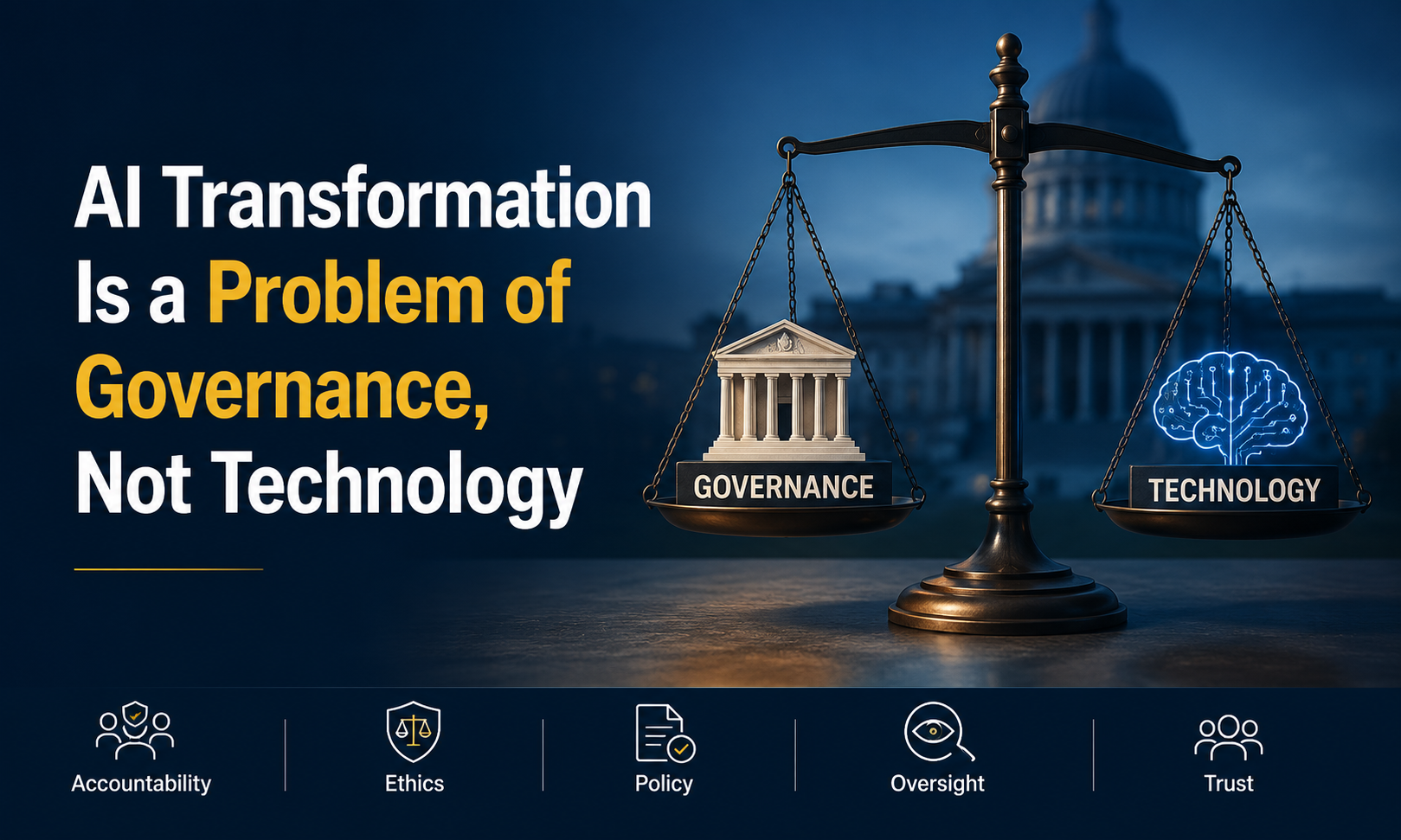
Artificial Intelligence (AI) has rapidly evolved from a futuristic concept into a critical business capability. Organizations across industries are investing heavily in AI-powered tools, automation platforms, predictive analytics, and machine learning solutions. Yet despite the unprecedented enthusiasm and investment, many AI initiatives fail to deliver meaningful business outcomes.
The common assumption is that these failures stem from technological limitations, insufficient data, or a lack of technical expertise. However, a growing body of evidence suggests a different reality: AI transformation is fundamentally a problem of governance, not technology.
While advanced algorithms and powerful computing infrastructure are important, they are rarely the primary obstacles to successful AI adoption. Instead, organizations struggle with decision-making frameworks, accountability structures, ethical considerations, regulatory compliance, and organizational alignment. In other words, the challenge is not building AI—it is governing it effectively.
Understanding AI Transformation Beyond Technology
AI transformation refers to the process of integrating artificial intelligence into business operations, decision-making processes, customer experiences, and strategic planning. It often involves significant organizational change, including new workflows, revised business models, and cultural adaptation.
Many executives approach AI transformation as a technology project. They invest in software, hire data scientists, and purchase cloud infrastructure. However, AI systems do not operate in isolation. They influence employees, customers, regulators, stakeholders, and society as a whole.
This broader impact introduces complex governance questions:
- Who is accountable for AI-generated decisions?
- How should organizations manage algorithmic bias?
- What safeguards protect customer privacy?
- How can businesses ensure transparency and explainability?
- Who monitors compliance with emerging AI regulations?
Without clear answers to these questions, even the most sophisticated AI systems can create significant risks.
Why Governance Matters More Than Technology
Technology is often the easiest part of AI transformation. Today, organizations have access to powerful AI platforms, pre-trained models, cloud services, and automation tools. Building an AI solution has become increasingly accessible.
Governance, however, requires organizations to establish policies, processes, and oversight mechanisms that guide how AI is developed, deployed, and monitored.
Successful AI transformation depends on governance in several key areas:
1. Strategic Alignment
Many AI projects fail because they are disconnected from business objectives. Organizations frequently deploy AI because it is trendy rather than because it solves a meaningful problem.
Governance ensures that AI initiatives align with organizational goals, customer needs, and long-term strategy. Decision-makers must evaluate whether an AI application supports measurable business outcomes before committing resources.
Without strategic governance, AI investments often become expensive experiments with little return on investment.
2. Accountability and Ownership
One of the biggest governance challenges in AI transformation is determining responsibility.
When an AI model makes a flawed recommendation or causes unintended consequences, who is accountable?
Is it the data science team, the technology vendor, the business unit, or executive leadership?
Effective governance frameworks establish clear ownership structures. They define roles and responsibilities across the AI lifecycle, ensuring accountability for both successes and failures.
Organizations that lack accountability often face operational confusion and increased risk exposure.
3. Ethical Decision-Making
AI systems can unintentionally reinforce bias, discriminate against certain groups, or produce unfair outcomes. These issues are not merely technical defects; they are governance concerns.
Ethical AI requires leadership oversight, organizational values, and decision-making processes that prioritize fairness and inclusivity.
Governance frameworks should address:
- Bias detection and mitigation
- Fairness assessments
- Human oversight requirements
- Responsible use policies
- Ethical review boards
Technology alone cannot determine what is ethical. Human governance must provide that direction.
4. Regulatory Compliance
Governments worldwide are introducing regulations to govern AI development and deployment. Businesses must navigate evolving legal requirements related to data privacy, algorithmic transparency, cybersecurity, and consumer protection.
Organizations that focus exclusively on technology often overlook compliance risks until problems emerge.
Strong governance frameworks help organizations:
- Monitor regulatory developments
- Implement compliance controls
- Conduct risk assessments
- Maintain audit trails
- Demonstrate accountability to regulators
As AI regulations continue to expand globally, governance will become even more important.
The Growing Risk of Governance Failure
History shows that technological innovation often advances faster than governance structures.
AI is no exception.
Organizations frequently deploy AI systems without fully understanding their implications. This can lead to:
- Reputational damage
- Regulatory penalties
- Legal challenges
- Customer distrust
- Operational disruptions
For example, biased hiring algorithms, discriminatory lending models, and flawed facial recognition systems have generated public controversy and regulatory scrutiny. In many cases, the underlying technology functioned as designed. The real failure occurred in governance, oversight, and risk management.
This highlights a critical lesson: an AI system can be technically successful while simultaneously creating governance failures.
Building an AI Governance Framework
To achieve sustainable AI transformation, organizations must establish comprehensive governance structures.
An effective AI governance framework typically includes:
Executive Leadership Involvement
AI governance cannot be delegated solely to IT departments or data science teams. Executive leaders must actively participate in defining policies, risk tolerances, and strategic priorities.
Leadership involvement ensures that AI decisions reflect organizational values and business objectives.
Cross-Functional Collaboration
AI affects multiple stakeholders across an organization.
Governance teams should include representatives from:
- Technology
- Legal
- Compliance
- Human Resources
- Risk Management
- Operations
- Executive Leadership
Cross-functional collaboration helps organizations identify potential risks before they become major issues.
Continuous Monitoring
AI systems are dynamic. Their performance can change over time due to shifting data patterns, evolving customer behavior, and changing market conditions.
Governance frameworks must include ongoing monitoring and evaluation processes to ensure continued effectiveness and compliance.
Transparency and Documentation
Organizations should document how AI models are developed, trained, tested, and deployed.
Transparency supports:
- Regulatory compliance
- Internal accountability
- Stakeholder trust
- Risk management
Comprehensive documentation also makes it easier to explain AI-driven decisions when questions arise.
The Future of AI Transformation
As AI capabilities continue to advance, governance will become an increasingly important competitive advantage.
Organizations that establish strong governance frameworks will be better positioned to:
- Build customer trust
- Navigate regulatory changes
- Reduce operational risks
- Scale AI initiatives responsibly
- Achieve sustainable business value
Conversely, organizations that treat AI transformation purely as a technology project may struggle with compliance challenges, ethical concerns, and stakeholder resistance.
The future of AI success will not be determined solely by who has the most advanced algorithms. It will be determined by who governs those algorithms most effectively.
Conclusion
The widespread belief that AI transformation is primarily a technological challenge overlooks the deeper reality facing modern organizations. While technology enables AI capabilities, governance determines whether those capabilities create value or introduce risk.
Successful AI transformation requires clear accountability, ethical oversight, regulatory compliance, strategic alignment, and continuous monitoring. These governance principles provide the foundation for responsible and sustainable AI adoption.
Ultimately, the question is no longer whether organizations can build powerful AI systems. The more important question is whether they can govern them effectively. In that sense, AI transformation is not a technology problem—it is a governance problem.